Diatonic Harmonica Note Layout Explained (Key of C)
Every blow, draw and bent note on a 10-hole C harmonica, why the layout looks odd, and how the three octaves differ.
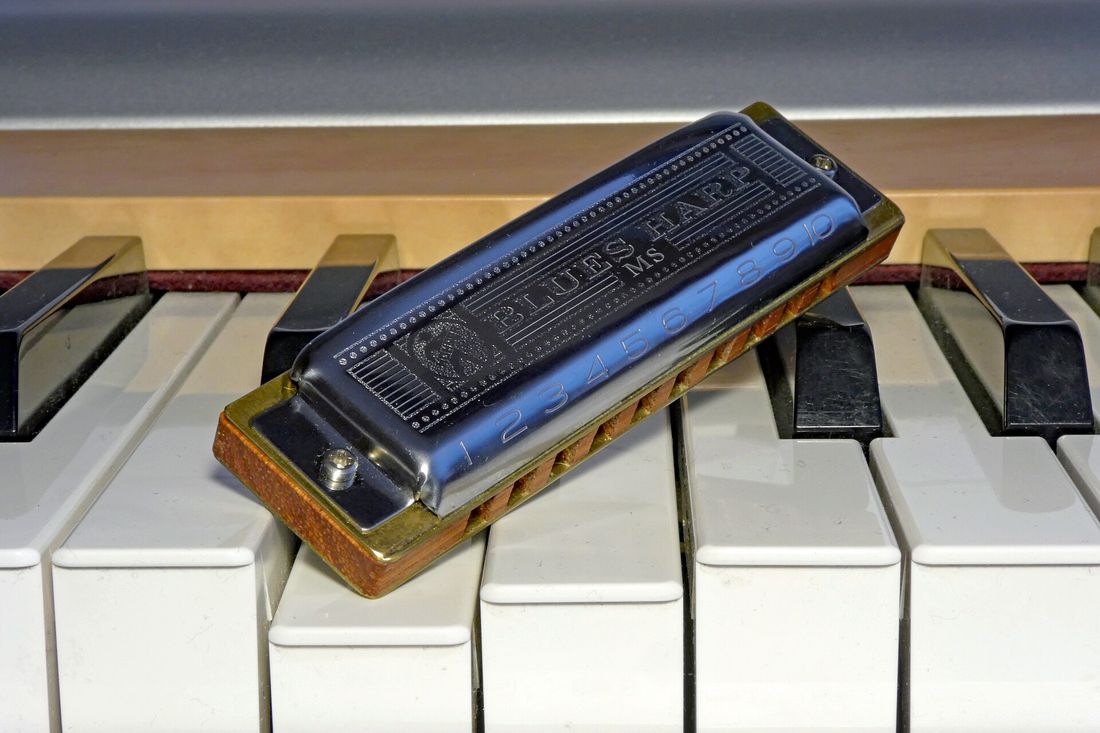
A 10-hole diatonic harmonica holds 20 reeds: one blow reed and one draw reed in each hole. The way those 20 notes are arranged is called Richter tuning, and it has barely changed since the nineteenth century. Understanding it explains why some tunes are easy, why others need bends, and why the top of the instrument feels back to front.
The full layout
Here are all the notes of a harmonica in C.
| Hole | 1 | 2 | 3 | 4 | 5 | 6 | 7 | 8 | 9 | 10 |
|---|---|---|---|---|---|---|---|---|---|---|
| Blow | C | E | G | C | E | G | C | E | G | C |
| Draw | D | G | B | D | F | A | B | D | F | A |
Blow notes: one chord, three times
Look along the blow row: C, E, G, repeated. Those three notes form the C major chord. Breathe out through any group of neighbouring holes and you get a pleasant C chord. You cannot play a wrong blow chord.
Draw notes: a second chord
The draw notes on holes 1 to 4 are D, G, B and D. The notes G, B and D form a G major chord, and adding the F on hole 5 makes it a G seventh chord. This is deliberate. The instrument was designed so that breathing out and in gives the two most important chords in the key, which makes simple song accompaniment easy.
It is also the reason blues players favour the draw notes, as described in our guide to harmonica positions.
The three octaves
The harmonica covers three octaves, and each behaves differently.
Low octave: holes 1 to 4
1   -1   2   -2 (or 3)   -3   4
C    D   E    G           B   C
Two notes of the scale are missing: F and A. They were sacrificed to make room for the chords. To play them you must bend, which is why melodies written low on the harmonica often need bending skills. Notice too that hole 2 draw and hole 3 blow are the same note, G.
Middle octave: holes 4 to 7
4   -4   5   -5   6   -6   -7   7
C    D   E    F   G    A    B   C
This is a complete major scale with nothing missing. Almost every beginner tune lives here, and it is where you should spend your first months.
High octave: holes 7 to 10
7   -8   8   -9   9   -10   10
C    D   E    F   G    A     C
Here one note is missing, B, and the breathing pattern is reversed. In holes 1 to 6 the draw note is higher than the blow note. In holes 7 to 10 the blow note is higher. To go up the scale you now draw first and then blow.
The bent notes
Bending fills in many of the gaps. A note can be bent down towards the pitch of the other reed in the same hole. On holes 1 to 6 you bend the draw notes; on holes 8 to 10 you bend the blow notes.
| Hole | Bend | Notes you gain on a C harmonica |
|---|---|---|
| 1 | Draw, one semitone | D flat |
| 2 | Draw, one or two semitones | F sharp, F |
| 3 | Draw, one, two or three semitones | B flat, A, A flat |
| 4 | Draw, one semitone | D flat |
| 5 | No true bend | Only a slight dip in pitch |
| 6 | Draw, one semitone | A flat |
| 7 | No true bend | Only a slight dip in pitch |
| 8 | Blow, one semitone | E flat |
| 9 | Blow, one semitone | G flat |
| 10 | Blow, one or two semitones | B, B flat |
The two notes missing from the low octave are there: F is the two-semitone bend on hole 2 (-2''), and A is the two-semitone bend on hole 3 (-3'').
Learn how in our lesson on bending notes.
Other keys work the same way
Harmonicas are made in all twelve keys, and the layout is identical in every one. Only the starting note changes. On a G harmonica, hole 4 blow is G instead of C, and everything else shifts with it. This is why a tab written for one key can be played on any harmonica: the hole numbers stay the same and the tune simply comes out higher or lower.
See our harmonica keys chart for the notes in every key.
What to memorise first
You do not need to learn the whole table at once. In order of usefulness:
- The middle octave scale:
4 -4 5 -5 6 -6 -7 7. - The fact that blow notes always make the home chord.
- The reversal at hole 7.
- Where the missing notes are in the low octave.
With those four facts you can make sense of nearly every beginner tab.
Filed under: Learn