How to Read Harmonica Tabs: A Complete Beginner's Guide
Learn to read harmonica tabs in ten minutes: what the numbers mean, blow and draw notes, bend marks and how to work out the rhythm.
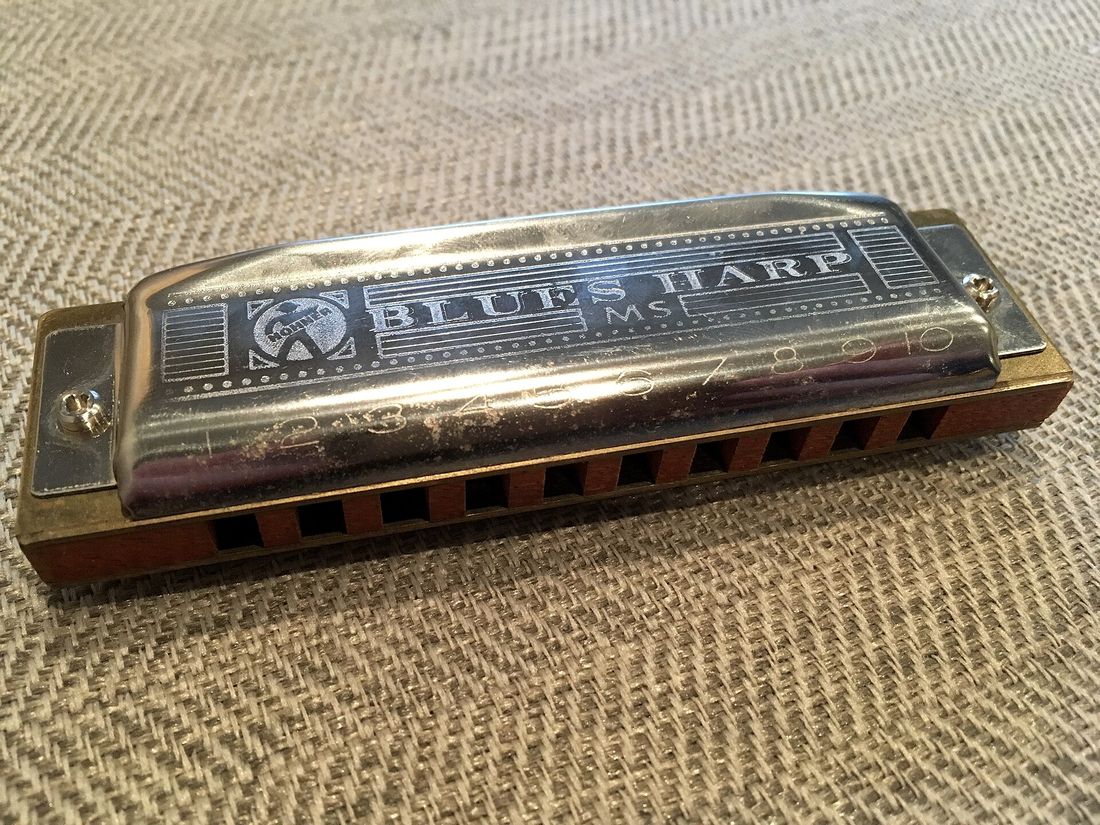
Harmonica tablature, or "tab", is a way of writing music that tells you which hole to play and whether to breathe out or in. You do not need to read sheet music. If you can count to ten, you can read a harmonica tab.
This guide explains the notation used on every tab page of this site.
The basic idea
A standard diatonic harmonica has ten holes, numbered 1 to 10 from left to right, with the lowest notes on the left. Most harmonicas have the numbers stamped on the top cover.
Each hole gives you two notes:
- a blow note, when you breathe out through the hole;
- a draw note, when you breathe in through it.
A tab is simply a row of hole numbers with a mark showing blow or draw.
Our notation
| Symbol | Meaning | Example |
|---|---|---|
| A plain number | Blow (breathe out) | 4 = blow hole 4 |
| A minus sign before the number | Draw (breathe in) | -4 = draw hole 4 |
| One apostrophe | Bend the note down a semitone | -4' |
| Two apostrophes | Bend the note down two semitones | -3'' |
| Numbers joined in brackets | Play the holes together as a chord | (4 5 6) |
So this line:
4 -4 5 -5 6
means: blow 4, draw 4, blow 5, draw 5, blow 6. On a C harmonica those notes are C, D, E, F and G, the first five notes of the C major scale. Try it now.
Other systems you may meet
There is no single standard, and other websites and books use different marks. The most common alternatives are:
- Arrows: an up arrow for blow and a down arrow for draw.
- Letters:
4Bfor blow and4Dfor draw. - Plus and minus:
+4for blow and-4for draw. - Brackets:
4for blow and(4)for draw.
They all carry the same information. Once you know one system you can read the others after a moment's adjustment. Always check the key or legend at the top of a tab before you start.
The C major scale in tab
The middle of the harmonica, holes 4 to 7, holds a complete major scale. It is the first thing worth memorising:
4  -4  5  -5  6  -6  -7  7
C   D  E   F  G   A   B  C
Notice what happens at the top. The pattern is blow-draw, blow-draw, blow-draw, and then draw-blow on hole 7. From hole 7 upwards the draw note is the lower of the two. This catches every beginner out at least once.
What about rhythm?
A tab tells you which notes to play, but usually not how long to hold them. That is its main weakness compared with sheet music. There are three ways round it:
- Know the tune. Tabs work best for songs you can already hum. Your ear supplies the rhythm.
- Follow the phrases. On this site each line of tab matches one line of the song, so you can see where to breathe and pause.
- Listen first. If a tune is new to you, listen to a recording a few times before you pick up the harmonica.
The key of the harmonica matters
A tab is written for a harmonica in a particular key. Play the same tab on a harmonica in a different key and you will get the same tune, just higher or lower. This is one of the great conveniences of the instrument: learn a tab once and you can play it in any key by picking up a different harmonica.
Every tab on this site is written for a C harmonica unless the page says otherwise.
Reading bends
Marks such as -3' or -2'' ask you to bend a note, which means lowering its pitch by changing the shape of your mouth. Bending is an intermediate skill. If you are just starting, choose tabs with no apostrophes; we label them "no bends" on each tab page. When you are ready, read our guide to bending notes.
Your first tab
Here is a tune everybody knows, "Twinkle, Twinkle, Little Star":
4  4  6  6  -6  -6  6
-5  -5  5  5  -4  -4  4
6  6  -5  -5  5  5  -4
6  6  -5  -5  5  5  -4
4  4  6  6  -6  -6  6
-5  -5  5  5  -4  -4  4
Play it slowly. If you hear two notes at once, do not worry: that is normal at first. Our lesson on holding the harmonica and playing single notes will fix it.
Quick summary
- A number means blow; a minus sign means draw.
- Apostrophes mean bends, which you can ignore for now.
- Holes 4 to 7 give you a full major scale.
- From hole 7 upwards, the draw note is lower than the blow note.
- Tabs do not show rhythm, so learn tunes you already know first.
Filed under: Learn